
Table of Contents
Your dog’s muzzle is going grey, the naps are getting longer, and suddenly the dog food aisle feels like a trick question. Every bag screams “senior formula,” every brand promises the best dog food for older dogs, and none of them agree with each other.
Here’s the honest truth: there is no single bag that wins for every old dog. A sprightly 9-year-old Lab and a stiff 14-year-old Chihuahua have very different needs. But there is a clear nutritional profile that aging dogs do best on — and once you know what to look for, picking the right food gets a whole lot simpler.
This guide walks you through exactly that: what older dogs actually need, how the main food types compare, how to read a label without a chemistry degree, and how to switch foods without a week of stomach drama.
What Makes the Best Dog Food for Older Dogs?
Forget the marketing. “Best” comes down to nutrients, and senior dogs have a pretty specific wishlist. Let’s go through it piece by piece.
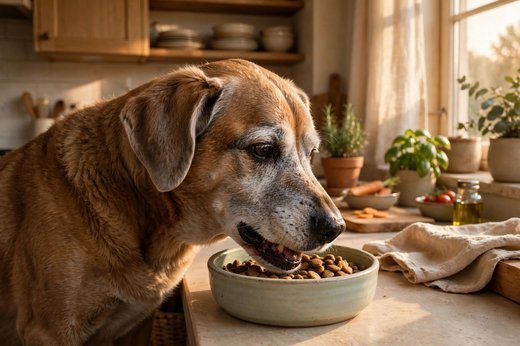
Protein: more than you’d think. This is where most people get it backwards. For years, the conventional wisdom was that old dogs need less protein to “spare” their kidneys. That advice has largely been flipped on its head. Aging dogs actually need plenty of protein to hold on to muscle mass — and muscle is what keeps an old dog mobile, steady on stairs, and able to get up off the floor without help.
Unless your vet has specifically put your dog on a protein-restricted diet for kidney disease, don’t shy away from foods with solid, named animal protein. Look for something in the range of 25% protein or higher on a dry-matter basis, with real meat — chicken, beef, fish, lamb — sitting at the top of the ingredient list.
Fat and calories: less is more. Here’s the flip side. An older dog’s metabolism slows down, and most seniors are moving a lot less than they used to. That combination means weight gain creeps up fast, and extra weight is brutal on arthritic joints. Many senior dogs do well on roughly 20% fewer calories than they needed in their prime — but that’s a starting point, not a rule. A lean, active 10-year-old needs more than a couch-loving 13-year-old.
The practical move: pick a food with moderate fat (not the ultra-rich performance formulas), feed for the weight your dog should be, and adjust based on the ribs. You should be able to feel them easily under a thin layer of fat.
Fiber: the unsung hero. Older digestive systems get sluggish. A bit of extra fiber — from ingredients like beet pulp, pumpkin, or oatmeal — keeps things moving and helps dogs feel full on fewer calories. If your senior has started having irregular stools, fiber is often the first thing worth checking on the label.
Joint support: glucosamine, chondroitin, and omega-3s. Most dogs over 10 have some degree of arthritis, whether they’re showing it yet or not. Foods formulated for seniors often include glucosamine and chondroitin, plus omega-3 fatty acids (EPA and DHA, usually from fish oil). These won’t rebuild a worn-out joint, but they can take the edge off stiffness and support the cartilage that’s left. If your dog’s food doesn’t include them, a vet-approved fish oil supplement is a simple add-on.
Moisture and minerals: easy on the kidneys. Aging kidneys don’t filter quite like they used to. Foods with moderate — not excessive — phosphorus and sodium levels are kinder to them, and anything that adds moisture to the diet (we’ll get to wet food in a minute) is a quiet win for kidney and urinary health.
Put it all together and the ideal senior profile looks like this: high-quality animal protein up front, moderate fat and controlled calories, good fiber, joint-supporting nutrients, and sensible mineral levels. That’s the yardstick to measure every bag against.
One caveat worth stating plainly: if your dog has kidney disease, heart disease, or another diagnosed condition, the ideal profile above takes a back seat to your vet’s prescription diet. Therapeutic foods exist for a reason, and no over-the-counter senior formula replaces a diet your vet chose for a specific illness. When in doubt, bring the bag — or a photo of the label — to your next checkup and ask.
Kibble vs. Wet vs. Fresh: Which Suits Your Dog?
This is where people ask me the big question: what is the best food for senior dogs — kibble, wet, or one of those fresh-delivery services? The honest answer is that the format matters less than the nutrients inside it. But each type has real pros and cons for an aging dog.
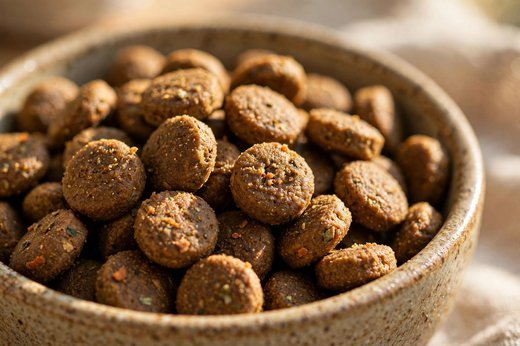
Kibble (dry food) is the default for a reason. It’s affordable, easy to store, easy to portion, and the crunching does a little bit of dental work. For seniors, look for smaller kibble pieces — a lot of old dogs have worn teeth or sore gums, and giant nuggets become a chore. If your old dog is a small breed, small breed senior dog food is formulated with those tiny mouths in mind. The downside? It’s only about 10% moisture, which isn’t doing your dog’s kidneys any favors, and some seniors just find it boring as their sense of smell fades.
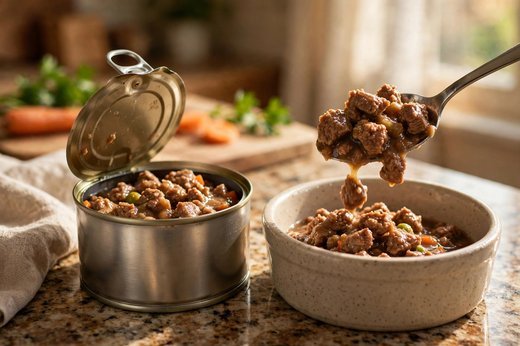
Wet food (canned) is the senior-dog sleeper hit. It’s typically 75–80% moisture, which is genuinely helpful for kidney and urinary health. The strong smell and soft texture make it far more appealing to picky old eaters, and dogs with missing or painful teeth handle it easily. Downsides: it costs more per calorie, it won’t do anything for teeth, and an open can needs refrigerating.
Fresh and home-delivered foods have exploded in popularity, and the good ones are genuinely well-formulated. Dogs tend to love them. The catch is price — feeding a large senior this way gets expensive fast — and quality varies wildly between companies. If you go this route, apply the same label standards as any other food (more on that below).
The move most senior-dog owners land on: a mix. A base of good senior kibble with a scoop of wet food on top gives you the best of both — dental crunch, extra moisture, better smell, happier dog. There’s no single best food for senior dogs in the abstract; the best format is the one your individual dog will actually eat eagerly, that fits your budget, and that hits the nutrient profile above.
How to Read a Dog Food Label Like a Pro
You don’t need to memorize ingredient dictionaries. Five checks will tell you most of what matters.
1. Find the AAFCO statement. This is the single most important line on the bag, and most people skip it. Look for wording like “formulated to meet the nutritional levels established by the AAFCO Dog Food Nutrient Profiles for maintenance” (or “all life stages”). AAFCO — the Association of American Feed Control Officials — sets the baseline nutrient standards pet foods are measured against. No statement, no purchase. It’s that simple.
2. Read the first five ingredients. Ingredients are listed by weight, so the first handful tells you what the food mostly is. You want to see named animal proteins up there — “chicken,” “deboned salmon,” “lamb meal” — not vague terms like “meat and bone meal,” which tell you almost nothing about what’s actually inside.
3. Check the guaranteed analysis. This is the protein/fat/fiber/moisture panel. Compare it against the senior profile: solid protein, moderate fat, decent fiber. Don’t obsess over a point or two — look at the overall picture.
4. Find the calorie content. It’s usually tucked away in small print (“3,400 kcal/kg” or “320 kcal/cup”). You need this number to portion correctly, especially since seniors need fewer calories than the feeding guide’s “average” assumes.
5. Ask the healthiest-food question directly. When people ask what is the healthiest dog food for senior dogs, the real answer is never a brand name — it’s a profile. The healthiest option for your dog is the one with an AAFCO statement, named meat proteins up front, senior-appropriate fat and fiber levels, joint-supporting nutrients, and a calorie count that lets you keep your dog lean. If a food checks those boxes, the brand on the front barely matters.
One more thing: be skeptical of foods that split ingredients to look better than they are. If you see “peas, pea starch, pea protein, pea fiber” scattered through the list, that’s one ingredient wearing four disguises to push meat higher up the order. It’s legal, but it’s not honest.
Switching Foods Without the Stomach Drama
Found a better food? Great — now don’t just dump it in the bowl tomorrow morning. An older dog’s gut is less forgiving than it used to be, and a sudden switch is a fast track to diarrhea, gas, and a very unimpressed senior staring at you at 3 a.m.
Do it over 7 to 10 days:
- Days 1–3: 75% old food, 25% new
- Days 4–6: 50/50
- Days 7–9: 25% old, 75% new
- Day 10: 100% new
If your dog has a famously sensitive stomach, stretch it to two weeks — there’s no prize for speed here. And if at any stage things go sideways (loose stool, vomiting, total food refusal), drop back to the previous ratio for a couple of days before moving forward again. Persistent problems after two weeks mean the new food probably isn’t the right fit, not that you transitioned wrong.
Signs the New Food Is Actually Working
Give any new food a fair trial — at least 6 to 8 weeks — before judging it. Then look for these:
- Coat and skin. A dull, flaky coat that turns softer and shinier is one of the first visible wins, usually thanks to better fats and omega-3s.
- Energy and mobility. Not puppy energy — that’s not coming back. But a dog that’s a bit more willing on walks, or gets up a little easier, is telling you something.
- Stool quality. Firm, consistent, not too frequent — the poop never lies.
- Weight. The ribs test every couple of weeks. The goal is lean, not skinny.
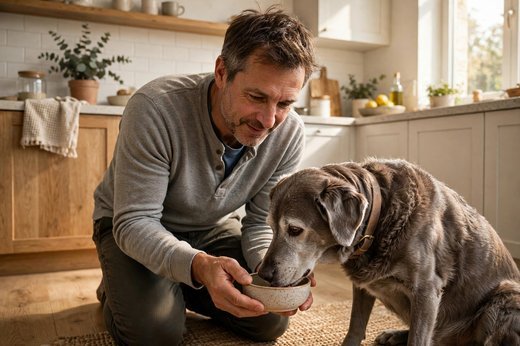
- Enthusiasm at mealtimes. An old dog that trots to the bowl is a dog whose food agrees with them.
If you’re seeing the opposite — dull coat, weight creeping up (or dropping), chronic soft stool — the food isn’t right, no matter how premium the bag looked.
The Bottom Line
Finding the best dog food for older dogs isn’t about finding a magic brand — it’s about matching a nutrient profile to the dog in front of you. Plenty of protein to protect muscle, controlled calories to protect joints, fiber for the gut, omega-3s and joint nutrients for the stiffness, and a label that passes the five checks above.
Start with what’s in the bowl now, compare it honestly against that profile, and switch gradually if something better fits. Your old friend has given you their best years. Getting the food right is one of the simplest, highest-impact ways to pay that back.